Aboriginal art and party time
After our wonderful visit to the Desert Park at Alice Springs our coach driver took us on a short tour of Alice Springs (commonly abbreviated to “The Alice”).
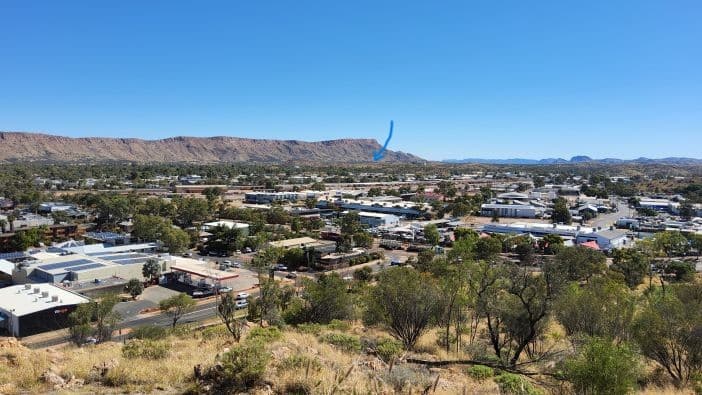
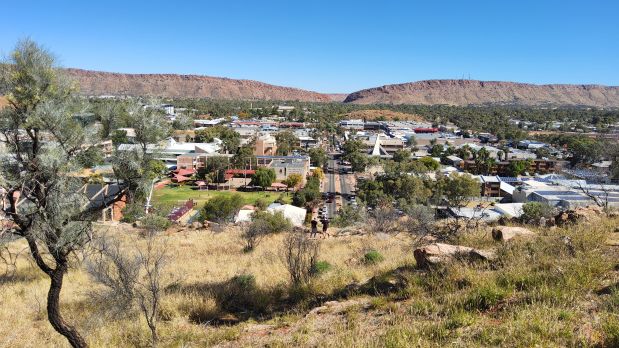
Alice Springs lies almost exactly in the centre of Australia, midway between Darwin and Adelaide. Surrounded by desert ranges and ancient landscapes, it began as a telegraph station in the 1870s, built to link the continent to the rest of the world by the Overland Telegraph Line. What was once a remote outpost grew into a permanent settlement, serving as a supply base and meeting point for people crossing the desert interior. Its existence is still tied to that role—a centre of communication, transport, and services in the middle of a vast, sparsely populated region. We admired the view from Anzac Hill, which is The Alice’s war memorial.
From there, we were taken to the Yubu Napa art gallery. That turned out to be far more interesting than an opportunity to buy a souvenir. The owner gave us a short talk explaining Aboriginal art. There’s a common belief that Aboriginal art was started by a white man in the 1970s. That’s at best an oversimplification. The use of dots has always been part of Aboriginal ceremonial designs, sand drawings, rock art, and body painting going back thousands of years. The modern acrylic “dot painting style” emerged in Papunya (near Alice Springs) in the early 1970s, when Aboriginal men, encouraged by schoolteacher Geoffrey Bardon, began painting their Dreaming stories on board and canvas instead of in sand or on skin. To protect sacred knowledge from outsiders, they used dots and patterns to obscure certain details while still expressing the story. So while the medium and visibility of dot painting as a commercial art movement took shape in the 1970s, the roots of the technique are ancient, tied to ceremonial and cultural practices that long predate European contact.
Certainly since the 1970s Aboriginal art has evolved. Artists still tell their cultural stories but increasingly the scope has expanded to more esoteric subjects. And why not? Art never stands still.
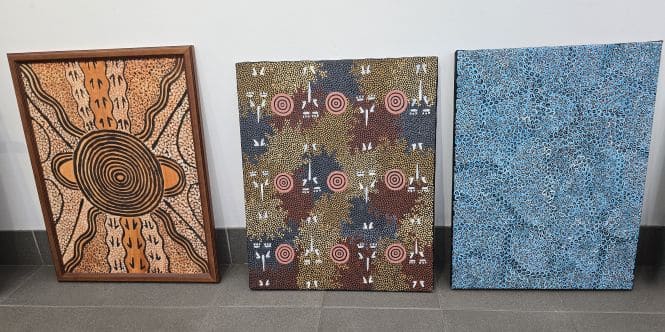
In the first two paintings above the artist is telling the exact same story to do with hunting kangaroos at water holes. The first is a simpler pattern from the 70s, drawn by an elder in the sand to teach boys, the second is a derivation of the same story. The third is an abstract.
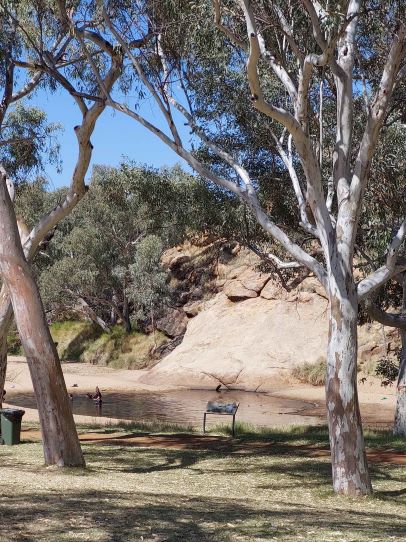
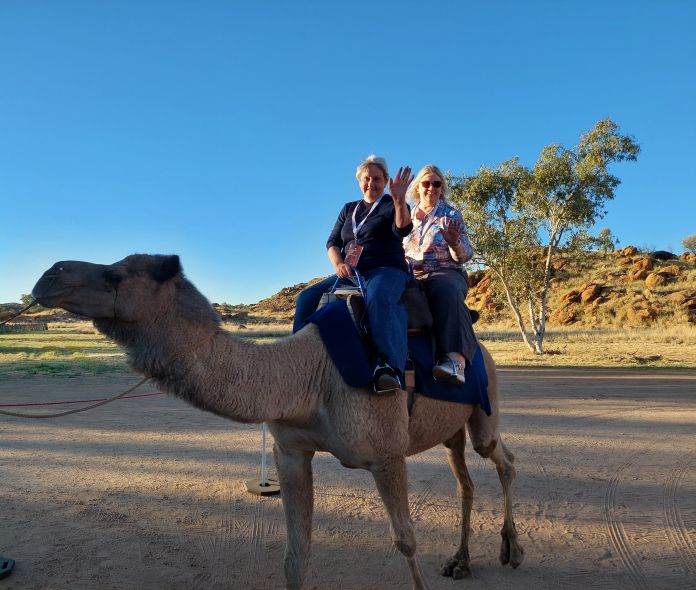
We were taken back to the train to get dressed in warm clothes for our dinner that night, under the stars at the old telegraph station where Alice Springs started and which is now a museum. The desert can be cold at night. Between 1871 and 1933, the township’s name was Stuart and Alice Springs was simply the name of the waterhole adjacent to the telegraph station, and named after Alice Todd, wife of Superintendent of Telegraphs Sir Charles Todd, who oversaw the construction of the Overland Telegraph Line. In 1933 Stuart was renamed Alice Springs. Before sunset (which was unfortunately dead boring) we visited the buildings and/or went on a short camel ride.

The food was good, much alcohol was consumed, and towards the end of the evening they turned off most of the lights and a local astronomer used a laser pointer to explain the constellations in the brilliant southern sky. It’s not my picture, not that night, but that’s the southern sky in all its desert glory. Some Aboriginal people say the Milky Way is a river in the sky, marked by the campfires along its length. Others say it’s the rainbow serpent. Whatever. It’s a magnificent sight, something you’ll never see in a city with its light pollution.

People danced to the music provided by a band and that vibe continued for the folks who kept the party going on the train. We went to bed.
Tomorrow would be another big day when we visit Coober Pedy in South Australia.
By the way, if you’ve happened across this post by accident, see the whole trip here.