Alice Springs
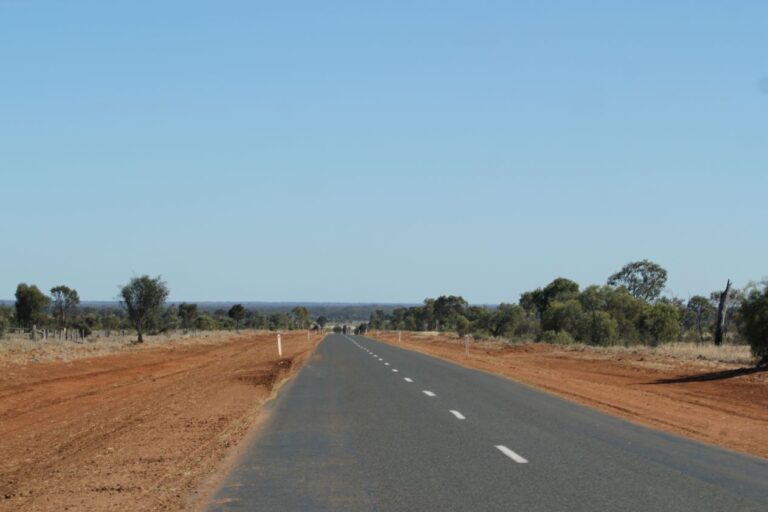
The Ghan travelled south through flat, uninspiring semi-desert as we enjoyed dinner and on through the night.

The next morning we stopped at Alice Springs. Pete and I had been there just last year and visited the attractions in and around the town – Simpson’s Gap, Standley Chasm, and a quick lunch stop at the Desert Park. The next day we visited the School of the Air and the Flying Doctor. These were all on the list of excursions from the train (as well as a quick flight to Uluru, but we did that last year, too). This time it had to be the Desert Park.
The Alice Springs Desert Park is one of Central Australia’s most remarkable attractions, offering a window into the landscapes, plants, and animals of the desert. Just outside town, the park combines natural habitat with cultural insight, showcasing how the Arrernte people have lived with and cared for this environment for thousands of years. Visitors can wander through desert rivers, sand country, and woodland habitats, see rare and elusive wildlife in the nocturnal house, and watch free-flying birds of prey in daily shows.
Our guide was Arrernte man Jeremy, who told us something about his culture between visits to the animals and birds. He showed us a map of the different language and cultural groups across the country. Have a look at it to show how diverse aboriginal culture is. He explained which of the groups he could (sort of) talk with and the many where the languages are very different.
He explained “skinship”. Aboriginal kinship systems are like a set of rules that tell people who they can and can’t marry. In many groups, everyone belongs to a “skin group” or subsection. These groups are passed down through families in strict patterns, and each group has certain groups it is allowed to marry into. Because the rules are so clear and cover the whole community, people automatically avoid marrying close relatives, even if they don’t know exactly how they’re related. The system works like an inbuilt map that spreads relationships out widely, keeping the gene pool healthy and preventing inbreeding.
People are divided into eight skin groups (subsections). Each person is born into a skin group based on their parents’ groups, and each group has strict rules about who they can marry.
For instance:
- A man in skin group A is only allowed to marry a woman from group B.
- Their children will then automatically belong to group C.
- Someone in group C must marry from group D, and so on.
This cycle is worked out for all eight groups, so everyone knows who they can marry and what group their children will belong to. Because the rules connect across the whole community, it prevents people from marrying close relatives—cousins, siblings, or other too-close relations fall into the “wrong” skin groups.
He showed us Aboriginal weapons created from the tough mulga wood. He showed us very briefly plants used for food or medicine.
Before we left, he told us people like him did not approve of the behaviour of the Aborigines in town. The young people had no respect. They had no knowledge of their own culture and what the bush could teach them. He said if people like him didn’t tell about their culture, in fifty or sixty years it would have disappeared. There is a serious youth crime problem in many Australian cities, especially Darwin, Alice Springs, Townsville, Cairns – cities with large Aboriginal populations. We were warned by friends not to go to Darwin’s CBD at night. People like Jeremy despair. They try to encourage the kids to get jobs on Country but it’s difficult.
We weren’t told all this in one session – in between all this we visited the animals and birds.
Australia’s native dog, the dingo, was introduced from Asia long ago. He might look like a dog and can mate with dogs but there are differences. Dingoes have a longer, flatter skull than dogs, they have larger shearing teeth (upper fourth premolar and lower first molar), adapted for cutting meat and bone, and wider zygomatic arches – the cheekbones flare more, giving extra bite strength. Most interesting is that, like wolves, they have a single breeding season per year, unlike many domestic dogs that can breed year-round.

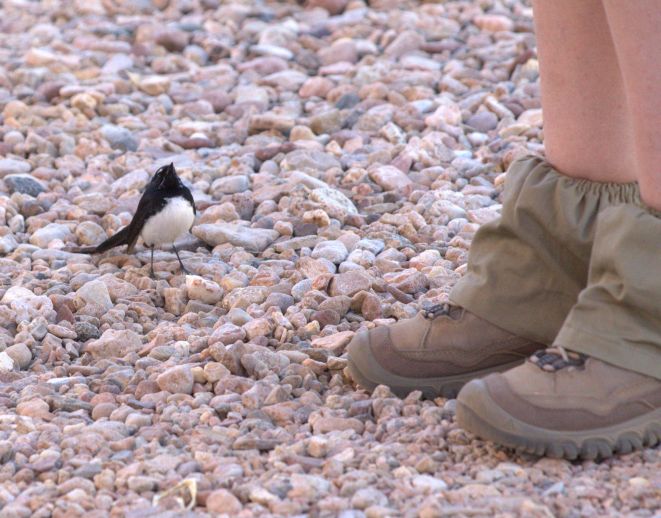
The bird show was wonderful. The ranger was immediately joined by a willie wagtail who wasn’t part of the show but hung around for the treats. She first worked with a whistling kite which can snatch food and then eat while flying. I’ve put links to information about the various birds we saw.

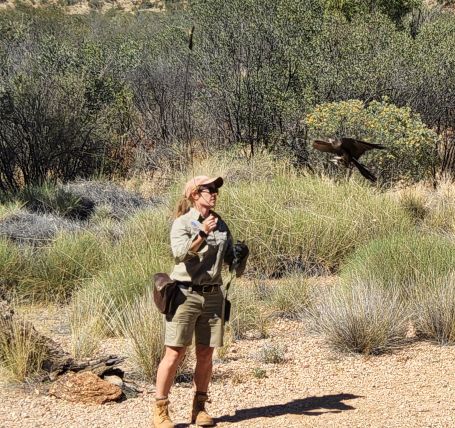
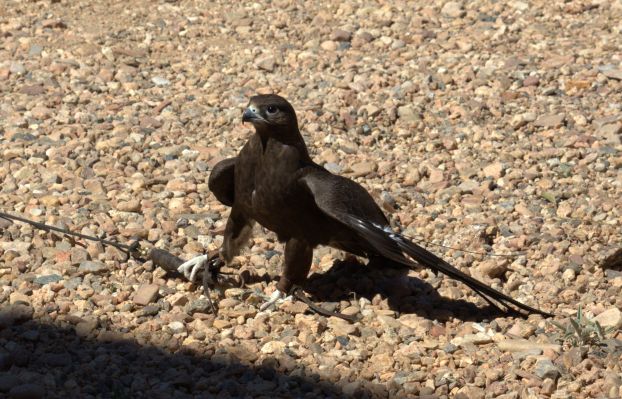


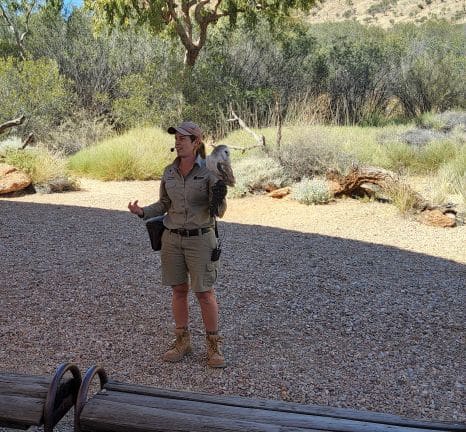
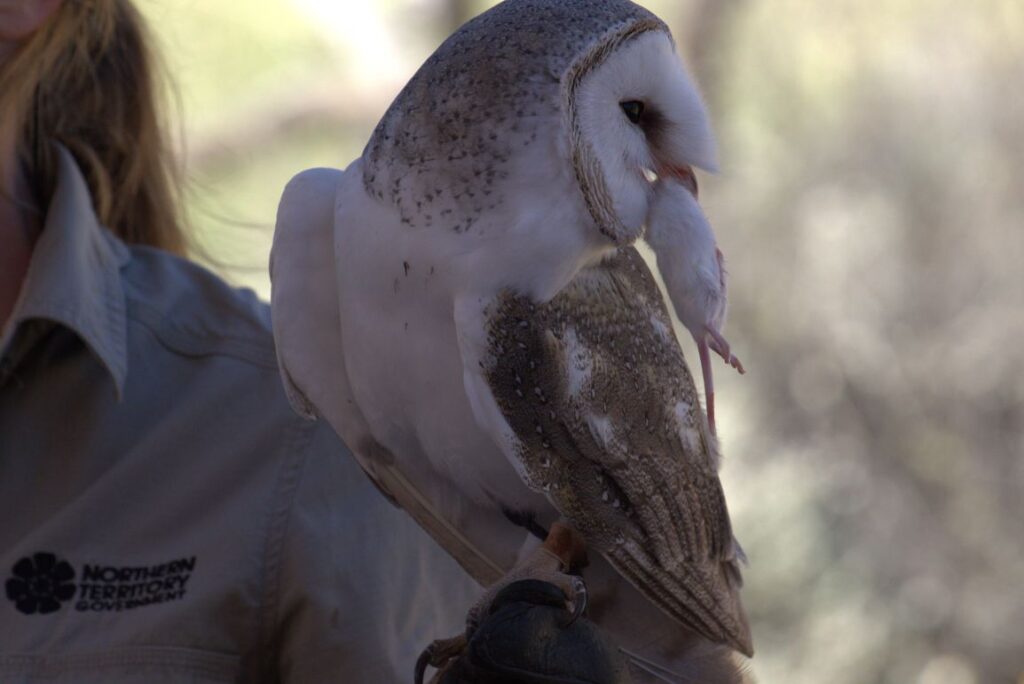


The big buzzard can break into an emu egg, picking up a stone to crack it. (It’s not a real emu egg but it’s just as tough). The ranger said it’s not a learned behaviour. The bird just knows how to do it.
Black falcons are very fast, maneuverable birds that predate on other birds in flight, such as pigeons and parrots. Last time we were here the ranger had a black falcon which was chowing down on a pigeon wing, feathers and all.
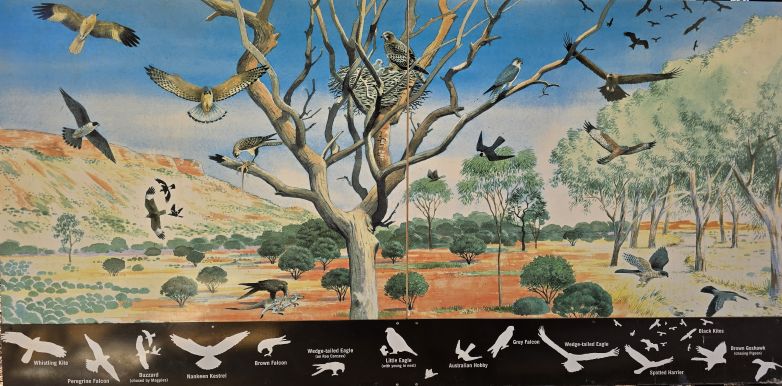
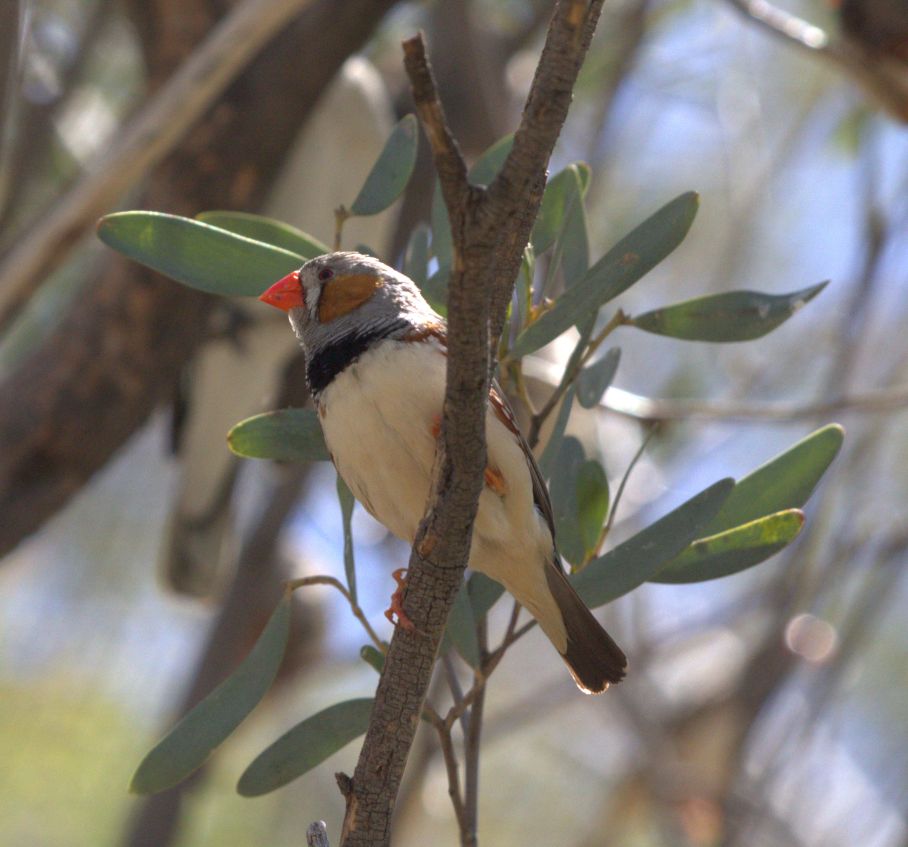
We also visited an aviary where some of the smaller birds lived.


And from there to the nocturnal house to see bilbies, echidnas, marsupial mice, snakes, and lizards.


It was a truly fascinating day. There was a bit more to enjoy when we left the Desert Park but I’ll show you that next time.
By the way, if you’ve happened across this post by accident, see the whole trip here.