The Breakaways

After our big day and evening in Alice Springs the train headed south and next morning it was stopped in the middle of an empty landscape with flat horizon on all sides. We were at Manguri Station. Due to the lack of infrastructure, I assumed that ‘station’ wasn’t a place where trains stopped, it was the Australian equivalent of ‘ranch’. Wrong. “Manguri Station isn’t a vast pastoral station but rather a proclaimed town and railway station in South Australia. It is located near Coober Pedy on the east side of the Adelaide–Darwin railway line.” In fact it’s a siding so the train could stop off the main line.
There you go.
The Ghan staff put down steps at the train exit doors and helped the elderly down onto the stony red dirt so we could make our way to the waiting coaches. Unfortunately, one excursion, the flight across Kati-Thanda (Lake Eyre), had to be cancelled so the other excursions had expanded numbers. We hadn’t signed up for the flight – we’d flown over the lake some years ago. It’s quite spectacular. Here’s my blog post from that time. But we were ‘bumped’ from the tour we’d selected. We were going to visit the Breakaways.
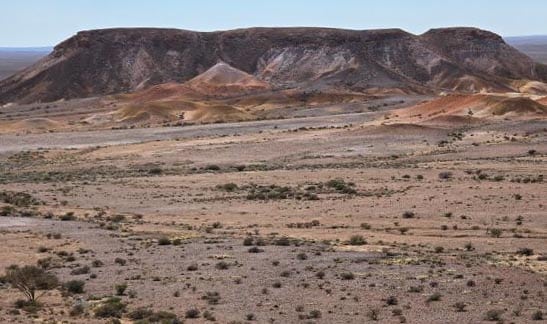
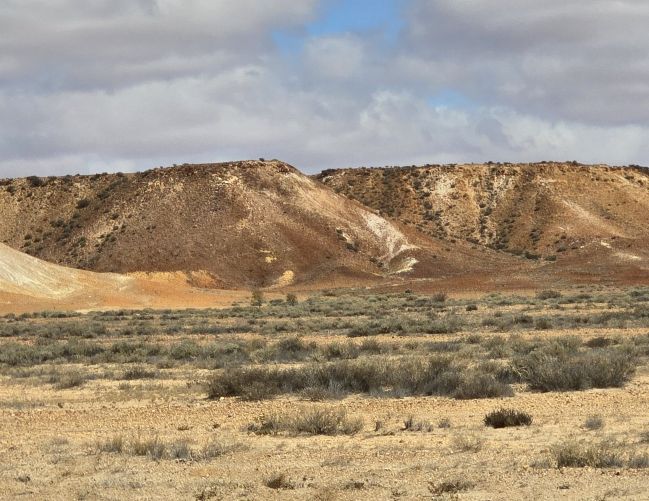
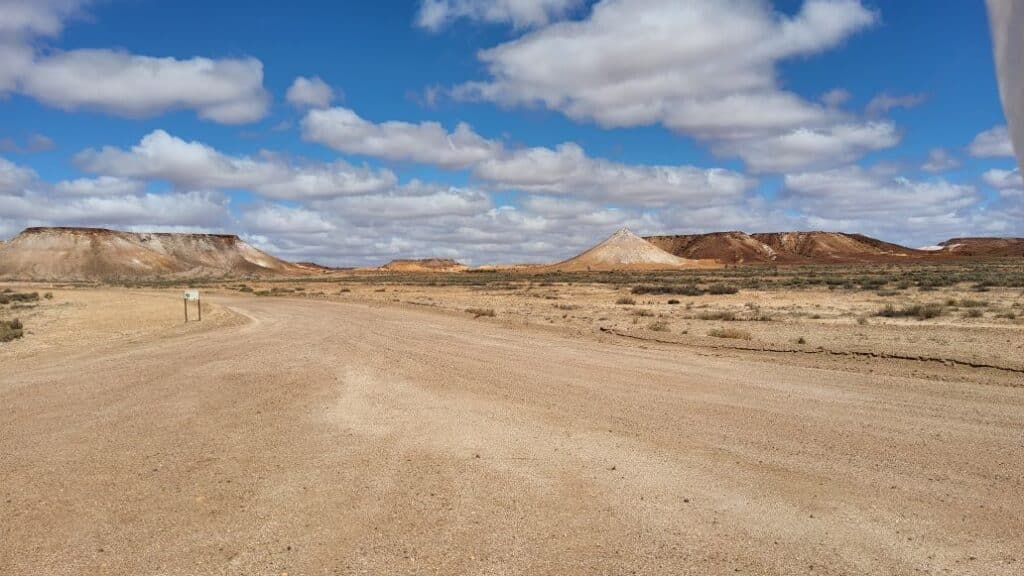
Everybody knows the middle of Australia is flat. In fact, the lowest point in Australia is 15m below sea level and it’s in Kati-Thanda, which is about 250km from Coober Pedy. So it shouldn’t be a surprise to learn that the Breakaways are eroded mesas and low hills that were once part of the ancient inland sea that covered much of central Australia around 70 million years ago. The colourful cliffs and flat-topped formations are mostly made of sandstone and siltstone capped with a harder layer of ironstone and silica that resists erosion. Over millions of years, wind and water stripped away the softer rock, leaving the isolated outcrops that “broke away” from the main range. Fossils of marine creatures, including plesiosaurs, have been found in the region, confirming its oceanic past.

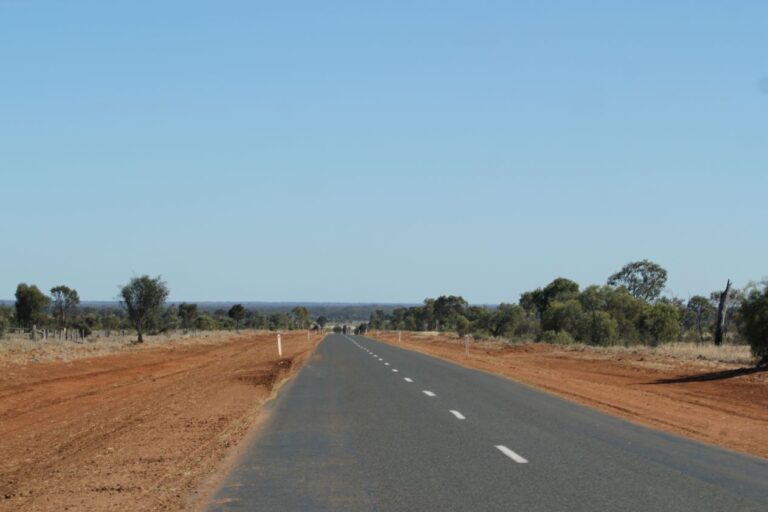
There’s no bitumen out here. The coach threw up clouds of dust as it drove along the dirt roads into the strange bare hills of the Breakaways. The area is a conservation park and it has never been mined. What you see is what nature has wrought. Our driver stopped the bus and went to find fly nets for us all but the guide waiting for us said, “Don’t bother, Hank. It’s blowing a gale out here. No flies.” And also no hats. They’d be halfway to Adelaide before you noticed they’d gone. An icy wind tore across the desert so hard you had to push against it to stay still. Our local guide, Duncan, did his best in the difficult conditions to explain the geology of the place and introduce us to some of the plants. But some of the less fit, and some with hearing aids, gave up and went back to wait in the bus. The 7-y-old twins didn’t come, either. They would have ended up chasing the hats.
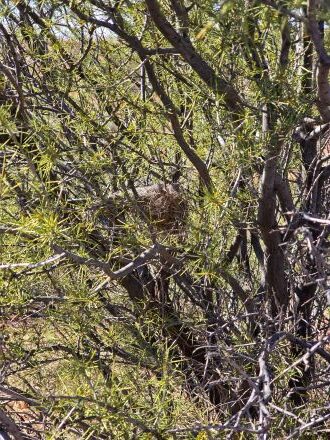
Anything living out here has to be tough. It doesn’t rain much. Moisture comes in the form of condensation. The picture below is what Duncan described as the ‘dead end’ plant. It’s so tough that if you see these dying, it’s the end. It’s also a prickly bush that’s perfect for the nests of little birds like the zebra finch.

Duncan pointed out what looked like caves under the tough caps of the hills. Not a cave. Stick-nest rats (a native rodent) dig under the tough cap and collect sticks to build nests in the hollows. When dingoes and feral cats decimated the rats, the nests were empty. Wallaroos (small kangaroos) pulled the sticks out and used the hollows as shelter. And if they had to withstand winds like we encountered I’m not surprised.

After our short tour, Hank drove us around to where staff from the Ghan had set up a wind swept refreshment station offering coffee and tea and (of course) wine and beer. The lady filled Peter’s coffee cup halfway. “If I fill it,” she said, “half of it would blow away. Come back for refills.” Sparkling wine was easier – harder to blow out.

We had a last look at some of the more spectacular Breakaways formations. Bottom left is Papa Katjura or two dogs. (Cross your eyes and imagine two dogs lying down. No, I couldn’t see it, either.) The left ‘one ‘dog’is white because the protective top has disappeared, the other has retained the cap so still shows colour. The middle picture shows what happens when the cap disappears.


We headed for Coober Pedy, passing by the dingo fence as we went. The Dingo Fence is a 5,614 km barrier constructed in the 1880s to protect agricultural lands in southern Queensland and parts of New South Wales and South Australia from dingoes. It is the longest fence in the world and consists of wooden posts, wire netting, and is buried underground to prevent digging. The fence separates the (mostly) dingo-free sheep-grazing lands of eastern Australia from the rest of the continent.

As with so many of these human interventions, it has caused all sorts of problems. Sure, it keeps the dingoes out, to a certain extent. But the fence creates a significant ecological divide, altering native plant and animal communities on both sides. Inside the dingo-free zone, the absence of dingoes as a predator has led to higher populations of introduced feral cats and foxes. Cats and foxes prey heavily on small marsupials, like stick-nest rats, which are found in greater numbers on the “dingo side” of the fence where the dingo population remains. The presence of dingoes, in contrast, helps control herbivore populations and prevent excessive woody shrub encroachment, leading to more diverse vegetation within the dingo’s range.
Author’s note: I abhor these constructions. The sooner this fence, the emu fence, drum lines, shark nets, and anything else of that type is consigned to history, the better.
We’re on our way to the opal town of Coober Pedy. I’ll tell you about that next time.
By the way, if you’ve happened across this post by accident, see the whole trip here.