I Used to Speak Computer
Some of you may recall that back when I was working for a living, I was a computer programmer. That was before somebody invented the much sexier term, “software engineer”.
This was back in the early 1980s, when the IBM PC was being hastily cobbled together and the future arrived in beige plastic with a keyboard that could double as a blunt instrument. The original IBM PC, the 5150, came out in 1981. It had an Intel 8088 processor, floppy drives, and, depending on the model, a frankly hilarious amount of memory by modern standards.
I remember machines with 256KB of RAM. I also remember four-colour graphics. Not four million colours. Four. If you were lucky, one of them was cyan. The first version of SpaceQuest ran on that machine. Roger Wilco, space janitor, moved via the arrow keys and you had to type in commands. “Look in cupboard”; “Take gun”. Ah, those were the days.
The first machine I worked on was even more primitive. It had 4K of RAM and used two little cassette tapes, one for the program and one for the data. I don’t remember what it was called, but I do remember the process. Load the program. Wait. Hope. Load the data. Wait some more. Hope harder.
And yet I loved programming.
It sang a song in my brain. Not music, exactly, but pattern. Logic. Structure. You told the machine what to do, step by step, and if you got it wrong, it did exactly what you told it to do anyway, the smug little beast. If you could accept that fact, and set about finding out what YOU did wrong, then you could be a programmer. It was, and still is, an essential mindset.
People often assume programming is all about maths. It isn’t. Not really. It’s about logic. It’s about breaking a problem into pieces small enough for a very fast idiot to understand.
That suited me.
It’s also worth remembering that some of the earliest programmers were women. As usual, much of what they did was shoved under the table, ignored, or politely forgotten once the money and prestige turned up. Grace Hopper was one of the great pioneers of computer programming and was central to the development of COBOL, the business language that ran (and still runs) great chunks of the world for decades. And if you haven’t seen Hidden Figures, do. It’s a terrific film about the women mathematicians who helped put America into space.
I came into the industry when computers were just beginning to escape from glass rooms and specialist departments. I worked on databases, I wrote applications, and I was around for some of the earliest examples of websites. I saw the whole thing move from command lines and green screens to the internet, smartphones, apps, cloud storage, and devices that update themselves whether you like it or not.
Do I want to go back there?
Not really.
I loved the work, but modern tech is a different beast. It’s clever, certainly. It’s also bloated, tangled, over-designed, and far too fond of changing things that were working perfectly well last Tuesday.
My nodding acquaintance with technology still helps me navigate digital life. I can usually poke around, read the signs, and work out what’s gone wrong. But often, at the consumer end, there’s nothing you can fix. The settings are hidden, the useful buttons have vanished, and the software sits there looking innocent while you contemplate violence.
Then you have to contact support.
That means explaining the problem to someone following a script, while both of you silently pray the other person’s accent, microphone, internet connection, and patience will hold out long enough to get past step one.
And printers.
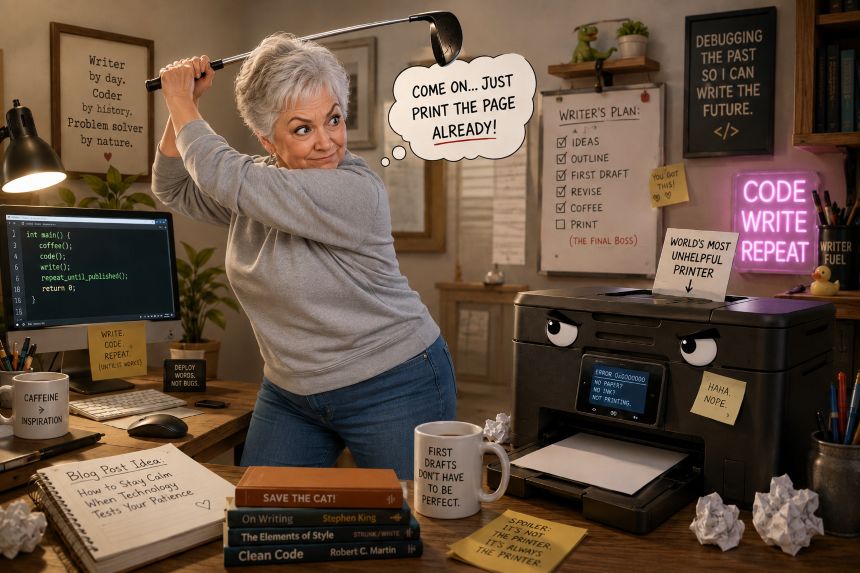
No. Don’t get me started on printers.
Printers are proof that humanity has not yet earned interstellar travel. We can send probes past Pluto, land rovers on Mars, and argue with artificial intelligence, but try printing a single page when the printer has decided it is “offline” despite sitting three feet away with all its lights on.
There is, of course, the old advice.
Have you tried turning it off and turning it back on again?
The annoying thing is, it often works. Only now it’s not enough to turn off the printer. You turn off the printer, reboot the computer, restart the router, threaten the modem, sacrifice a biscuit, and hope Windows remembers what a printer is.
Still, I’m not going back to a fountain pen.
I’m not going back to film cameras either. I loved them, but I don’t miss waiting to find out whether a photo worked. Digital photography is magic. Word processors are magic. Email is useful, even when it’s annoying. The internet is astonishing, even if large parts of it now resemble a shopping centre designed by caffeinated ferrets.
So here I am, still using technology every day, still grateful for it, still swearing at it, and still secretly pleased when the old advice works.
Turn it off.
Turn it on again.
Try not to bite the printer.
After all that muttering about technology, here’s one digital thing that should behave itself.
I have a free book you can download. No printer required. No ink cartridges. No support ticket. No cheerful little pop-up insisting everything is fine when it clearly isn’t.
Just a story, ready to read.