Give the women a go
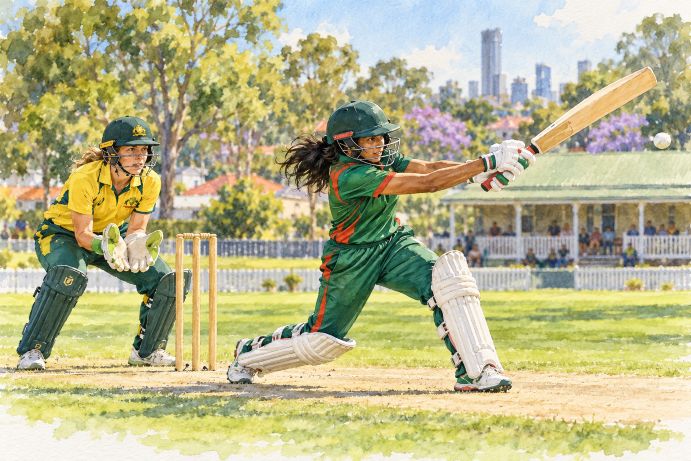
I watched some cricket this week. Australia playing Bangladesh in a women’s one-day international at Allan Border Field in Brisbane. And a very entertaining afternoon it was, too.
Women’s cricket, like so much women’s sport, tends to live in the shadow of the men’s game. I think that’s unfortunate. There’s plenty to enjoy if you give it a chance.
Yes, there are physical differences dictated by biology. Women generally don’t bowl as fast or hit the ball as far as the men. But how far does a six need to go? Once it’s over the boundary, you don’t get extra runs for landing it in somebody’s lunch.
You still see sparkling batting, hard-hit fours and sixes, quick running between wickets, incredible catches, and bowling that requires skill, control, and a working understanding of what the batter would rather you didn’t do.
There’s more to cricket than brute force.
Australia and Bangladesh have just completed a three-match one-day series in Brisbane, played from 9 to 14 October. Australia won all three matches, and the margins were comfortable. But that doesn’t mean there was nothing worth watching along the way.
The innings that caught my attention came from Bangladesh’s Sobhana Mostary in the second match. At 24, she scored 118, becoming the first Bangladeshi woman to make an international century against Australia. Captain Nigar Sultana supported her with an unbeaten 74. That took some doing against this Australian attack.
When you’re watching your own country play, you naturally want them to win. Even so, I was delighted to see Mostary reach her century. You can appreciate an opponent’s achievement without being required to hand back your Australian passport.
It was also wonderful to see the reaction when Mostary was out, bowled. She was bitterly disappointed and actually seemed quite shattered at having played a bad shot. Several of the Australian players took time to come over and congratulate her – just a pat on the back or a murmured ‘well played’. And the crowd gave her a standing ovation. That was when she managed a smile and a wave of her bat to acknowledge what she had achieved.
Then our openers got to work. Georgia Voll finished unbeaten on 131, while Phoebe Litchfield made 70. Watching those two bat together was a pleasure. Both are still in their early twenties, which gives Australian supporters plenty of reason to feel cheerful about the future.
We’ve been spoiled by the Australian women’s team over the years. Success has become something we expect. But a team doesn’t keep winning simply because its predecessors did. Players retire, younger ones step up, and somebody has to keep doing the work. Seeing that next generation arrive with such confidence is encouraging.
I was also pleased to see Bangladesh playing here.
Cricket’s international map owes a great deal to British history. Australia, England, New Zealand, South Africa, and the countries of the Indian subcontinent all inherited the game and made it their own. Bangladesh’s enthusiasm for cricket is hardly surprising.
What I admire is seeing its women take their place on the international stage.
Bangladesh is a country with far fewer resources than Australia. It’s also a Muslim-majority society with conservative expectations about women’s roles. I wouldn’t pretend to know what each player has faced to get here, or assume that every family has the same attitudes. But I don’t take their opportunities for granted.
Finding talented girls is only part of building a team. Those girls need somewhere to play, people to coach them, families who support them, and a reason to believe there’s a future in it.
That makes it a pleasure to see them walk onto an Australian ground and face some of the best players in the world. And when one of them scores a century, I think she deserves our applause.
Bangladesh has beaten India, too, including in the 2018 Women’s Asia Cup final. That wasn’t yesterday, but it’s a useful reminder that the established teams don’t own the results.
Of course, there’s still a gap between Bangladesh and Australia. The results of this series make that clear. But teams need opportunities to play stronger opposition if they’re going to improve. They also need audiences willing to watch them while they do it.
Peter has said more than once that he prefers watching women’s football (soccer) to the men’s game. His view is that the women tend to get on with playing, with less time spent rolling around clutching an ankle or auditioning for a penalty.
I can see his point. There are occasions in the men’s game when you wonder whether a stretcher or an acting award would be more appropriate.
That doesn’t mean every women’s match is wonderful or every men’s match is an exercise in theatrical collapse. But there’s a lot to be said for watching players who keep your attention on the game.
And that’s why I’d like to see women’s sport get more support. Watch a match. Learn a few names. Appreciate a well-placed shot, a clever delivery, or a catch you wouldn’t have managed with a fishing net.
I sat down to watch Australia play Bangladesh and enjoyed myself. Sobhana Mostary gave me someone new to applaud, and our young openers gave me something to look forward to.
That’s a pretty good return for an afternoon in front of the television.
There’s still about a week to run in the Books In Your Pocket Kickstarter. Please take a look and consider supporting Indie authors. If you support ANY of the reward tiers you can include as an add-on my latest book, An Unexpected Sunturn for just US$5. Click on the image.