Who actually pays?
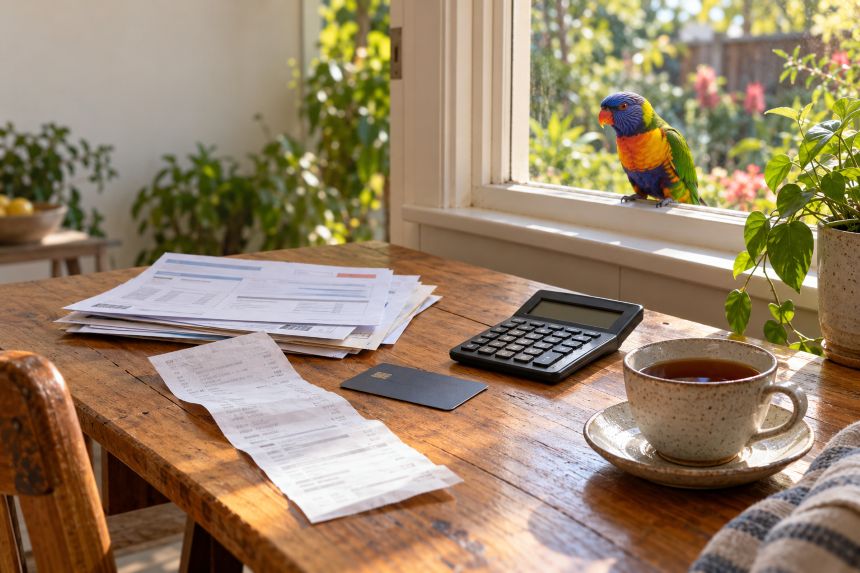
I was going to write something cheerful this week. Maybe share some of my lorikeet photos. Everybody loves them. Then I opened the newspaper. There went that idea.
I find this government so frustrating. So often it does things that have me raising my eyebrows and wondering who came up with that brilliant idea. Anti-semitism and the lack of action, energy policy, and the apparent belief that businesses can absorb whatever costs Canberra chooses to hand them are just three of the items that have me shaking my head.
Anti-semitism Matters
But let’s start with an anniversary that (most of) us do not celebrate.
Wednesday, October 7, marked three years since the Hamas-led attacks on Israel, when around 1,200 people were killed and 251 were taken hostage. Remembering those people should not require a political qualification. Nor should Jewish Australians have to defend themselves against hostility over events in another country.
The government has introduced legislation and adopted an antisemitism plan. But I believe its response has been too slow and inadequate. Announcing measures is one thing. Making people safe is the result that matters.
And I cannot believe that there are people in Australia who actually celebrated this most heinous of acts.
Energy Matters
This week, the High Court upheld the invalidation of approval for the Mount Pleasant coal mine expansion in NSW. The issue included the failure to properly consider the climate effects of emissions from burning its coal overseas. This was a court applying NSW law, but the implications for our resources industry deserve a serious political response.
We depend on coal export earnings while making its future production increasingly contentious. Coal isn’t our biggest export, iron ore earns more, but it is hardly a sideline. The government’s latest figures put thermal and metallurgical coal export earnings at a combined $70 billion for 2025–26.
I find the contradiction stunning. We value the income, jobs, and tax revenue. Yet the industry providing them is repeatedly treated as something we should be embarrassed about.
Meanwhile, here at home, I’m tired of electricity bill relief being presented as an answer to expensive electricity. Temporary help can matter to a household struggling to pay a bill. But taxpayers fund that help. Moving part of the bill onto the public purse doesn’t fix the cost of producing and delivering power.
How about a credible plan for affordable, reliable electricity, with the costs explained and the alternatives properly assessed? That should include nuclear power and high-efficiency, low-emissions coal generation. Neither is an instant solution or a free one. Neither should be dismissed without an honest comparison of cost, reliability, construction time, and emissions.
Then there’s Snowy 2.0. The latest report I found describes its tunnelling machine Florence as stalled for more than three months because of a cracked drill head. This is project is way over budget and probably should be scrapped. Its problems deserve scrutiny rather than another reassuring announcement.
I also want clearer explanations of how government investments are accounted for.
Money Matters
Some equity investments sit outside the underlying cash deficit, although they are disclosed elsewhere in the accounts and can require borrowing. That does not mean the debt is secretly missing. It does mean the deficit figure politicians quote isn’t the whole picture of the government’s cash requirements.
Calling something an investment should invite questions about its return, its risks, and who pays if it fails.
And now we have the credit card surcharge changes.
Lovely. The extra charge disappears from the checkout. Unfortunately, the cost of accepting the payment hasn’t disappeared from the business. The Reserve Bank has also reduced interchange fee caps, which should help. But even its own explanation acknowledges that a business may incorporate its remaining card costs into advertised prices.
So customers may still pay. The cost simply becomes less visible.
Small businesses pay tax too, Canberra. They also pay rent, wages, insurance, electricity, and the costs of complying with regulations. There is no bottomless bucket behind the counter.
Paying staff in Australia can feel like sitting an exam nobody gave you time to study for. The UK has four national minimum wage categories, based on age and apprenticeship status. Here, employers must identify the applicable award, classify each worker according to their duties, and calculate the relevant loadings, penalties, overtime, and allowances. That makes our system far more detailed than a simple minimum wage schedule. Workers deserve proper pay, but small business owners deserve rules they can understand without needing a payroll specialist on speed dial.
A business can absorb a cost only while its margins allow it. After that, it has to raise prices, reduce other spending, or reconsider whether staying open is worth it. And an awful lot are deciding it isn’t.
The Tax Office provided a particularly revealing example. It proposed stopping credit card payments because of the processing costs, then the government intervened after the backlash. Today’s announcement delays the change and provides transitional funding.
Apparently, payment fees are a problem when the Tax Office has to carry them. Business owners could have explained that without a consultation process.
We still have industry in Australia, and I don’t want to dismiss the people working in it. I want policies that give them a reason to keep investing and employing people here. Making production expensive and difficult does not make overseas competition disappear. And so many things that used to be made in Australia no longer are. Cement? Glass? Steel? Clothing? I’m sure you can think of more examples.
With energy costs, paperwork, and shifting rules to contend with, I can understand why someone would hesitate before starting a business. We should be making that decision easier.
I don’t expect miracles from government. I expect competence, clear priorities, and some understanding of how people earn the money that pays for all these policies. At $2 a litre, roughly 72 cents of what you pay for petrol goes to government in excise and GST.
Research commissioned by the Housing Industry Association puts taxes, regulatory costs, and infrastructure charges at almost half the price of a new house and land package in Sydney, and more than 40% in Brisbane. Governments talk about affordable housing while adding substantially to its cost.
Hey, Dr Chalmers, a cheaper-looking receipt is not necessarily a cheaper purchase. A rebate is not cheaper electricity. And an announcement is not a result.
Somebody has to ask who’s paying. Maybe that’s One Nation.
And on a lighter note, please have a look at our Books in Your Pocket Kickstarter. It’s a way of supporting small business. Because that’s what Indie authors are. Click on the image and see what’s on offer.

And just to finish off… here’s a bunch of lorikeets in committee.