The World Has Become Smaller, But Australia Hasn’t Moved
Australia is still a very long way from almost everywhere.
This isn’t a complaint, exactly. I love Australia. I wouldn’t live anywhere else. But nobody can look at a map and pretend we’re conveniently placed. We’re tucked away at the bottom of the world, surrounded by a lot of ocean and a great deal of “are we there yet?”
That’s especially true if you live in Perth, where I grew up. I’ve lived “over East,” as we West Aussies say, for thirty years now, but my loyalties are still very much in the West.
The difference is that distance no longer feels quite the same.
Australia was first deliberately settled by Europeans in 1788. The First Fleet took a bit over eight months to sail from Portsmouth to Botany Bay, stopping at Tenerife, Rio de Janeiro, and Cape Town along the way.
If you’re wondering why on earth they went anywhere near South America, good question. On a modern map it looks like a weird detour. But sailing ships didn’t simply draw a straight line and hope for the best. They followed the wind. Rio was also a major port where ships could take on fresh food, water, livestock, seed, tools, and other supplies before the long haul across the southern oceans.
So travelling to Australia was not a trip. It was an uprooting.
And once you left your homeland, you really left.
No video calls, no texts saying “just landed, all good.” Letters took months, if they arrived at all. Families said goodbye knowing they might never see one another again. That puts a different weight on the word migration.
Things improved with steam and diesel ships, of course. The journey was faster, safer, and a good deal less likely to involve being jammed into the lowest deck of a convict transport wondering what terrible life choices had brought you there. But even in the twentieth century, coming to Australia was still a major crossing.
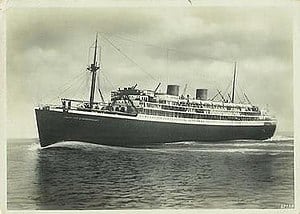
My own family arrived on the Johan van Oldenbarnevelt, a Dutch migrant ship that brought thousands of people to Australia in the post-war years. We were what you might call legal boat people. The voyage wasn’t the old sailing-ship ordeal, but it still took about a month. The ship went through the Suez Canal, stopped at places such as Port Said and Aden, then crossed the Indian Ocean to Fremantle.
A month is long enough to change the rhythm of your life.
Long enough for the ship to become a floating village, where children made friends, adults worried, seasick passengers cursed Poseidon, and everyone wondered what waited at the other end.
My parents never saw their parents again. We left Amsterdam when I was four, so I have no memory of my grandparents. That’s the part modern travel makes easy to forget. Migration wasn’t just packing a suitcase and changing your address. It could mean cutting your life in two.
Peter came by air in December 1974, on a British Airways flight. His route was no elegant nonstop leap. First Rome, then Bombay, Colombo, Darwin, and finally Melbourne. That was much faster than a month by sea, certainly, but still a journey made in stages, with pauses in faraway airports that sounded like names from an atlas. Back then, not all that long ago, Darwin’s passenger terminal was a tin shed. Quite the welcome for travellers arriving from a European winter into tropical summer, just a week before Cyclone Tracy came along to destroy the place.
And now?
For most Australians, a trip to Europe is usually done in two big hops. First you fly from Australia to a hub like Singapore, Hong Kong, Doha, or Dubai. Then, after the traditional airport delay, you board another flight to somewhere like London, Frankfurt, Paris, Rome, or Amsterdam. After that, if you’re heading to a smaller city, you catch another flight, a train, or whatever else gets you there without losing your luggage or your will to live.
That’s already astonishing compared with the old sea routes.
But there’s more. Now you can fly nonstop from London to Perth in under eighteen hours. Still uncomfortable if you’re wedged in economy next to someone who believes the armrest is their personal empire, but astonishing all the same.
In less than a day, you can cross a distance that once took months.
That changes more than travel. It changes imagination.
When the journey took months, Australia was another world. Not just far away, but almost mythic. You committed to distance, accepted separation, packed what you could, left what you couldn’t, and hoped the future would be worth the grief.
Now distance is more negotiable. Families scatter across continents and still talk over breakfast. News crosses the planet before anyone has time to make a cup of tea. A crisis in Europe, America, or the Middle East lands in our pockets within minutes. The world feels smaller because time has collapsed.
I’m not sure that’s entirely good.
We’ve gained so much. Speed. Connection. Opportunity. The ability to visit people we love without devoting half a year to the journey. I’ll take that, thanks very much.
But we’ve also lost something. The sense of distance as a real thing. The understanding that place matters. That oceans are vast. That migration is not just paperwork, luggage, and a customs declaration. It’s courage, loss, hope, and sometimes desperation.
Every time I think about those migrant ships, I think about people standing at the rail, watching the old world fade behind them. People leaving would throw paper streamers down to the people staying behind and hold them until they broke when the ship pulled away from the quay.
They didn’t know what they would find, couldn’t check online reviews, couldn’t text ahead, couldn’t look at street view. They were going into the unknown with trunks, children, accents, recipes, memories, and whatever stubborn optimism they could carry.
The world has become smaller since then.
But Australia is still a long way away. And perhaps it’s worth remembering that, now and then. Especially with all the turmoil in the Middle East.
Enjoyed this little wander through distance, ships, airports, and Australia being inconveniently located at the bottom of the map? (Or, if you turn the map over, the top of the map)
You might also enjoy one of my books. I write intelligent space opera with adventure, mystery, and a thread of romance, because apparently I never got over the idea of heading into the unknown.
You can download a free book here:
No passport required. No month at sea. No stopover in Darwin’s tin shed. Just a story waiting for you.