Arles
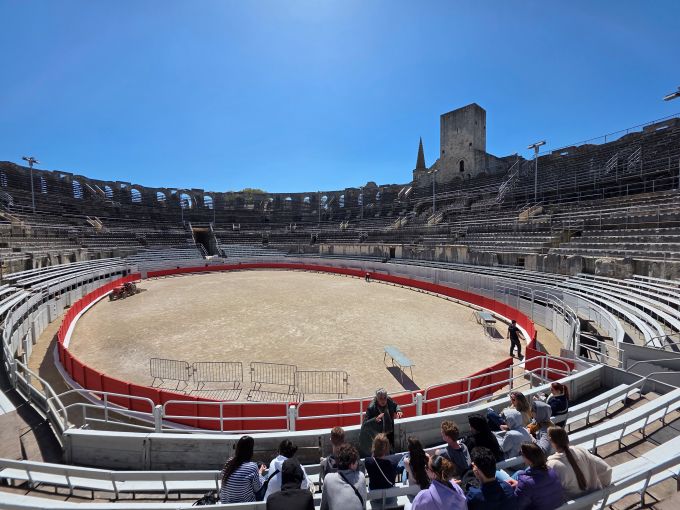
From Avignon we cruised down to the Provençal port of Arles. It’s famous for two things, its Roman past, which is still very much on display, and Vincent van Gogh. Being Dutch, I can pronounce his name properly, which is more than can be said for most people on the tour.
Roman times
Arles began as a Roman city and, unlike many places where you need a good imagination to picture what once stood there, here the past is still very visible. The Romans built big and built well, and a surprising amount has survived. The amphitheatre dominates the town, a solid oval structure that once held thousands of spectators for gladiator fights and public spectacles. It’s still standing, still used, and you can walk through it and get a real sense of the scale of Roman ambition.
Bullfighting
During our visit it was clear the arena was being prepared for a show. Our guide told us it would be a bullfighting event of the Spanish type, where the bull dies. I don’t like that sort of thing.
But in Arles, not all bullfighting ends in blood. Alongside the more controversial Spanish-style fights, there’s a distinctly local tradition known as course camarguaise, and it’s a very different beast. Here, the bull isn’t killed, and in fact it’s the star of the show. Young men, dressed in white and armed with speed rather than weapons, dart in to snatch small rosettes, ribbons, or pompoms tied between the bull’s horns or on its forehead. It sounds simple, but it’s anything but. The bull is quick, clever, and knows the game, often wheeling around with alarming precision to chase off would-be winners. The crowd cheers just as loudly for a skilful bull as for a successful grab, and the best animals become local legends, returning season after season like prized athletes. It’s fast, risky, and oddly respectful, a contest of agility and nerve rather than a fight to the death.
And it reminded me of that wonderful scene in Terry Pratchett’s Witches Abroad where junior witch Magrat marches up to the bull, whacks it, and takes the rosette from its forehead. (Girls can do anything.)
Gladiators
Back in Roman times, the arena served a similar purpose, though perhaps not quite as brutal as we imagine. Our guide explained that gladiators were more like today’s professional athletes. They were trained, valuable, and not usually killed outright. The contests were about spectacle and skill as much as blood. The tradition itself came from the Etruscans and was absorbed into Roman culture as their influence spread.
Not far away is the Roman theatre, older and more worn, but still impressive. Then there are the baths, fragments of walls, and columns that appear as you wander through the streets. It’s one of those places where history isn’t hidden away in museums, it’s simply part of the town.
van Gogh
And then there’s van Gogh. He arrived in Arles in 1888 and, in a burst of creative energy, produced some of his most famous works. The light in Provence clearly did something to him. You can still visit locations that appear in his paintings, the café terrace, the hospital where he was treated, and the surrounding countryside. It’s easy enough to match the scenes in front of you with what he painted, though thankfully without the accompanying personal turmoil.
Our guide reminded us of the incident with his friend Paul Gauguin, which ended with van Gogh cutting off part of his ear and handing it to a prostitute. Arles wasn’t particularly kind to him at the time, but it has since made a respectable living from his legacy. We were taken to a restaurant that looks very much like the one in his famous painting. Apparently it’s not the original. That, along with the house where he stayed, is long gone.
Arles the city
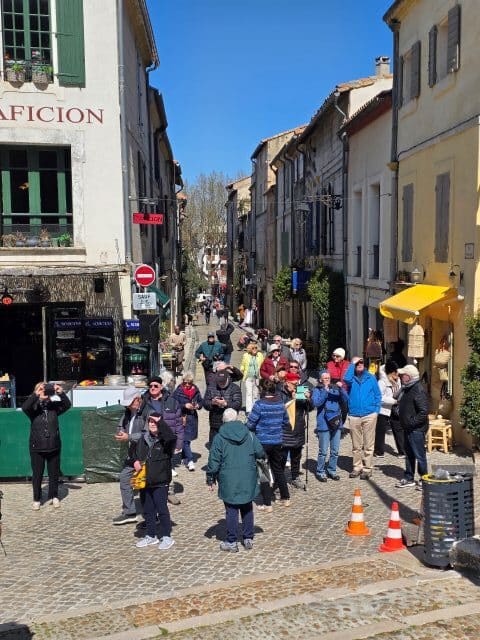
Arles itself feels less polished than some of the other places we’ve visited. It’s a working town as much as a tourist destination, which gives it a bit more character. Narrow streets, small squares, and shops that look as though they’ve been there forever. Life goes on around you rather than being staged for visitors.
After the grandeur of Avignon, Arles feels more grounded, but no less interesting. If anything, it’s easier to connect with. The Romans left their mark, van Gogh added his own, and the town simply carried on around both.
Once the tour ended, we decided to make our own way back to the ship using the paper map. I’m slightly surprised we’re not still wandering around the back streets if not divorced. But we made it, with sore feet, sore backs, and in need of a drink. Fortunately, that last requirement is very easy to satisfy on the ship.
If you enjoyed this article you might enjoy my books. My science fiction romance book The Iron Admiral: Conspiracy is free if you sign up for my newsletter. It’s fast-paced action all the way as star-crossed lovers race to stop a holocaust.
If you’ve missed any of the posts for this trip, go here. Europe 2026