The fatigue of permanent outrage
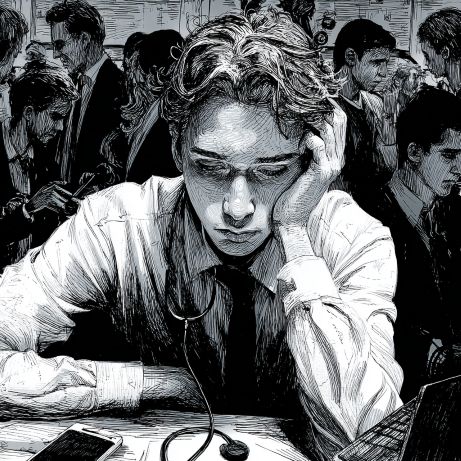
It feels as though we now live in a state of permanent outrage.
Every day brings a new crisis, a new scandal, a new moral emergency. Social media amplifies it, news cycles accelerate it, and before the previous issue has settled, another wave hits.
The result is not constant engagement. I don’t know about you, but I’m sick of hearing about the man formally known as Prince Andrew, references to Geoffrey Epstein makes my left eye twitch, even a mention of Harry and whatsername has me scrolling on by.
Psychologists have written about concepts like “compassion fatigue,” where repeated exposure to distressing events reduces our emotional responsiveness over time. Originally studied in caregiving professions, this idea now applies to how we consume crisis-driven media. When everything is urgent, the human nervous system simply cannot sustain continuous high alert. There’s only so much anybody can handle when it comes to images of Gaza or of the devastation in Ukraine.
It’s a known, studied condition. For example, the American Psychological Association reports that frequent exposure to news — especially negative news — can increase stress and anxiety levels:
The Reuters Institute Digital News Report finds that many people now avoid the news because it negatively affects their mood:
“News is doom and gloom: Why consume news when it’s so negative and depressing? In our research, we’ve found this is one of the primary reasons given for avoiding the news, along with a sense of fatigue and overload (Newman et al., 2022). People are fed up with political news, in particular, with people saying there is too much of it. They feel overloaded and bombarded by the amount of coverage, much of it negative.” People are turning away from the news. Here’s why it may be happening
This isn’t apathy. It is self-protection.
There’s also a structural problem. Modern media ecosystems reward intensity — particularly anger and conflict. As David Crotty puts it “The internet has largely become an attention harvesting mechanism in order to fuel advertising business models. Because of this, anger has become its most prized commodity, the more hateful and outraged, the more valuable. This drives engagement, and most of social media is designed to encourage and amplify it. As he puts it, outrage is “profitable, prevalent, potent, and performative.” [source]
The cost is subtle but real.
Outrage flattens complexity. Multi-layered geopolitical issues, historical grievances, and policy debates become binary theatre — you’re either virtuous or villainous, with no room for complexity. There’s no space to say, “This is complicated,” without being accused of cowardice or complicity. The weekly pro Palestine ‘protests’ in our capital cities are a case in point. Anger, outrage, zip understanding of the politics of the Middle East, most don’t know what river, what sea in the chant.
Over time, this creates fatigue. Not because people do not care, but because they care too much, too often, without pause.
Paradoxically, constant outrage can make it harder to address genuine injustice. When every issue is framed as existential, the signal gets lost in the noise. Urgency becomes routine. Crisis becomes background hum.
Democracies require sustained attention, not perpetual alarm. They need citizens who can distinguish between structural problems and symbolic skirmishes — something that becomes nearly impossible in an environment engineered for emotional spikes.
This does not mean disengagement. It means discernment.
It may mean choosing long-form analysis over breaking news, reading across diverse perspectives, turning off notifications, or allowing time between reaction and response.
History shows that societies have always faced conflict and moral struggle. What is new is the speed and volume with which we are asked to process them.
If we want durable civic engagement, we need something more sustainable than constant emotional combustion. Scrolling through your feed on Instagram is not a great way of absorbing real information such as you’d get from (dare I say it) reputable news organizations. But even they have succumbed to the click bait syndrome. These days an ordinary summer week in Perth with the temperature reaching forty degrees is treated as shock horror heat wave. (Flails arms) THE SKY IS FALLING. Climate Change!
Getting a week of around forty degrees happened in Perth every year for the forty+ years I lived there. But I guess “Perth endures a week of hot weather” isn’t as exciting as “Perth scorched!”.
So. As you know, in my spare time I write books – bracing science fiction adventures with a romance arc woven in. My latest offering, The President’s Daughter, is out tomorrow. Click the cover for the link. If nothing else, it will take you away to strange new worlds as you’re (virtually) chased by the mob. Oh – and that big leopard? He’s one of the good guys. His name is Maahes.