A Glimpse into Singapore’s War-Torn Legacy
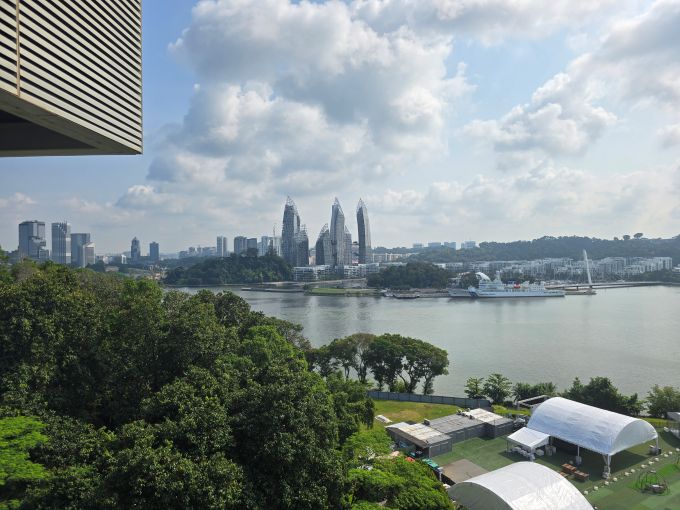
We started the day with a ride on the cable car over to Sentosa Island. It’s a pleasant trip with views over the crowded shipping lanes waiting to transfer cargo at Singapore’s harbour. We were told that the port is so busy they’re going to up-size again to a new port. After Shanghai, Singapore is still the second busiest port in the world.
Sentosa is a holiday island. It’s lined with (man-made) beaches, Universal Studios has a theme park, and the brand new Oceanarium is located there. So is Fort Siloso, the last remaining fort on Singapore and now a museum.

We alighted from the cable car and spent a forgettable ten minutes on a ‘nature walk’ along a boardwalk, where we saw a few peacocks. Half of the geology exhibit was closed, but this graphic was interesting since it showed the reclaimed land. In retrospect, we could have used that time at Fort Siloso.

A lift took us up to the level of the fort. You walk across via a walkway which gives great views of Singapore – but frankly, I’d seen enough of Singapore from on high and I didn’t much like standing around in the sun while our guide pointed out buildings.
Eventually we moved on to go through the chambers tunnelled into the hillside where the walls were covered in pictures and information about the occupation. Some of the guns are still there, along with a life size diorama showing how they were loaded. It’s famously said that Singapore’s guns all pointed in the wrong direction (out to sea) and they were not fired in anger. That’s not true. The guns were turned around – but it didn’t make much difference.
In February 1942, Singapore—then a British stronghold and colonial hub in Southeast Asia—fell to Japanese forces in one of the most dramatic defeats of the Second World War. The surrender marked the beginning of a brutal occupation that lasted three and a half years and left deep scars on the island’s people.
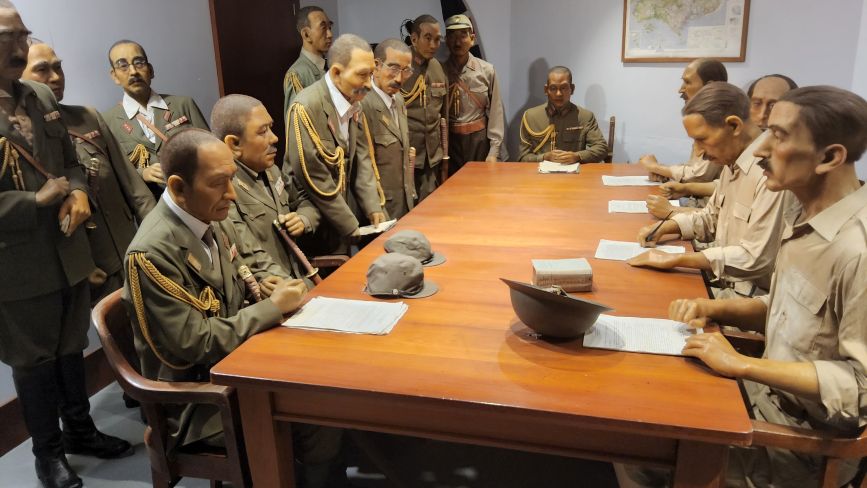
The British had long viewed Singapore as an “impregnable fortress,” banking on naval power and a strong coastal defence. But they were unprepared for a swift land invasion. Japanese troops advanced south through Malaya with speed and precision, using bicycles, tanks, and aircraft to overwhelm Allied forces. By 15 February, Lieutenant-General Arthur Percival surrendered to General Tomoyuki Yamashita at the Ford Factory, handing over more than 80,000 troops—the largest British-led surrender in history.
Winston Churchill was appalled. The International Churchill Society notes that Churchill explicitly instructed that Singapore was to be defended to the last man, with no surrender being contemplated. He expected the commander, staff, and principal officers to perish at their posts.
Under Japanese rule, Singapore was renamed Syonan-to (“Light of the South”). The occupation was marked by fear, censorship, forced labor, and widespread atrocities. Ethnic Chinese were singled out in a mass purge known as the Sook Ching massacre, during which thousands were executed on suspicion of anti-Japanese sentiment.
Food and resources were scarce. Locals endured rationing, inflation, and the constant threat of violence. Schools were closed or turned into Japanese-run institutions. Resistance movements formed in secret, but open defiance often led to imprisonment or death.
The occupation ended in September 1945, after Japan’s surrender. British forces returned, but the experience had changed Singapore forever. Trust in colonial rule was shattered. The suffering under Japanese control laid the groundwork for a new political consciousness—one that would eventually lead to independence.

One of those who escaped the Sook Ching massacre was Lee Kuan Yew, who would become first prime minister of Singapore.
“Under Japanese occupation in 1942-45, Lee worked as a translator for occupying forces, narrowly escaping execution when upon being asked to board a truck for relocation, sensed something amiss and excused himself to return home to collect a change of clean clothes. He stayed there for two days before returning to work, thus avoiding the massacre of Sook Ching.”
This obituary written in 2015 explains a lot about the man and the nation he founded and is well worth your time.
We didn’t have enough time at Fort Siloso, hurrying through the surrender chamber dioramas. Maybe the organisers can do something about that for next time.
I think that’s enough for this post. I’ll tell you want we did in the afternoon next time.
By the way, if you’ve come here by accident and want to follow the whole trip, tap here.