The Seventies Called. They Want Their Policies Back.
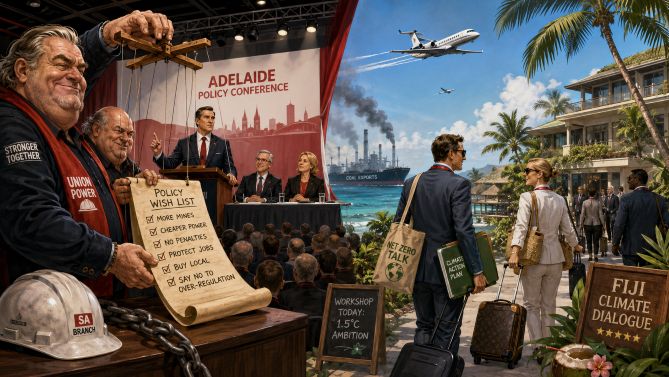
The Australian Labor Party is holding its fiftieth national conference in Adelaide this week. Or, as I prefer to think of it, the annual gabfest where several hundred people gather to decide how the rest of us ought to live.
Naturally, the unions have arrived with their shopping lists.
The Australian Manufacturing Workers’ Union wants a shorter working week without a reduction in pay. It also wants the Union Jack removed from the Australian flag, colonial statues taken down, changes to housing taxation and various other political and social reforms.
Some of those ideas might deserve a discussion. That is not really the point.
The point is that unions continue to exercise enormous influence over the Labor Party despite representing only a small minority of Australian workers.
According to the Australian Bureau of Statistics, 13.1 per cent of employees belonged to a union in their main job in August 2024. But membership falls to just 7.9% in the private sector. More union members now work in the public sector than in private enterprise. In 1976, 51 per cent of employees belonged to a union. Unions once represented most of the workforce. Now they represent about one employee in eight, yet their power inside the Labor Party remains substantial.
Unions were essential in the past. They fought for safer workplaces, reasonable hours, proper pay and protection from employers who regarded workers as replaceable machinery. Many of the conditions Australians now take for granted were won because people organised and refused to be exploited.
But organisations can outlive their original purpose. Or perhaps lose sight of it.
There is a considerable difference between protecting workers and making it almost impossible to operate a productive, sustainable business. Every new condition has a cost. Every shorter week, additional allowance, restriction, compulsory arrangement, and layer of compliance has to be paid for by someone.
Usually that someone is eventually the customer, the taxpayer, or the worker whose job no longer exists because the business has closed, automated or moved overseas.
Then there is the uglier side of union power.
Older Australians will remember the Builders Labourers Federation. In 1986, Bob Hawke’s Labor government cancelled its federal registration. Hawke was hardly an enemy of organised labour. He had been president of the ACTU before becoming prime minister. But even he recognised that there was a point at which militancy, intimidation and disregard for the law could no longer be tolerated.
The BLF did not simply turn into the CFMEU, although displaced BLF members were absorbed into unions that later became part of it. But the culture apparently survived.
The CFMEU’s Construction and General Division was placed under administration in August 2024 for up to five years. Courts have also imposed substantial penalties for unlawful conduct, including coercive threats on construction sites. These are not merely complaints from employers who dislike paying decent wages. They are findings and actions by courts and workplace regulators.
Protecting workers from exploitation is honourable.
Bullying workers and employers is not.
Meanwhile, the Adelaide conference has acquired an international sideshow.
Representatives from China and Taiwan were both attending as observers. Chinese diplomats demanded that two representatives from Taiwan’s de facto embassy be expelled.
Think about that for a moment.
Chinese officials came to a political conference in Australia and apparently believed they were entitled to decide who else could attend.
To Labor’s credit, national secretary Paul Erickson refused. The Taiwanese observers were entitled to remain, so the Chinese diplomats left. For once, the correct boundary was drawn. This is Australia, not a branch office of the Chinese Communist Party. [source]
I wish Australian governments showed the same backbone more often.
Our manufacturing capacity continues to shrink. Businesses face high energy costs, high wages, expensive regulation, and growing compliance burdens. Then politicians express surprise when companies manufacture their goods in China.
We impose costs here, export production there, import the finished products back, and congratulate ourselves on reducing Australian emissions.
The atmosphere, strangely enough, does not recognise national accounting tricks.
Which brings me to Chris Bowen, Minister for Increasing Energy Costs.
His department has reportedly set aside up to $4.2 million to reserve rooms at three five-star resorts on Fiji’s Denarau Island for delegates attending an October meeting ahead of COP31. The venues reportedly include the Sheraton, Sofitel and Radisson Blu. Some delegations will pay their own way, while Australia will cover costs for others. [source]
Hundreds of people will fly thousands of kilometres, stay in beachfront resorts and discuss reducing emissions.
Does anybody else see the irony?
Yes, international talks require people to meet. Yes, climate change is a global issue. But at some point the spectacle overwhelms the message.
Australia’s annual net greenhouse gas emissions were about 446 million tonnes of carbon dioxide equivalent in the year to December 2024. China accounted for around 32 per cent of global fossil carbon dioxide emissions in 2024, while India, the third largest emitter, accounted for about 8 per cent. China emits roughly Australia’s annual fossil carbon dioxide output in less than two weeks.
I should make my own position clear.
The climate changes. It always has and it always will. Human activity may influence the rate and extent of that change, but the idea that governments can dial the global temperature up or down by imposing higher electricity prices on Australians is absurd.
We are not going to stop climate change.
We should be preparing for it.
That means better flood mitigation, sensible building standards, improved water storage, stronger power networks, effective bushfire management, heat-resistant infrastructure and practical help for communities exposed to storms, droughts and rising seas.
It also means investing in research so cleaner energy becomes cheaper and more reliable than the alternatives. When that happens, countries will adopt it because it works, not because politicians have lectured them or signed another declaration at a luxury resort.
This is broadly the argument made by Bjørn Lomborg. Climate change is a problem, but it is not the only problem humanity faces, and throwing vast sums of money at expensive policies with tiny measurable effects is not sensible government.
We cannot freeze the climate at some supposedly ideal point in history. We can make societies wealthier, safer, and better able to cope with whatever the climate does.
Instead, Australia is damaging reliable electricity generation, driving industries offshore, and making households poorer while China and India continue to expand their energy use.
That is not saving the planet.
It is political theatre dressed up as virtue.
Crippling Australian industry will not save the planet if production simply shifts to countries using more coal and operating under weaker environmental standards. Closing a factory in Australia and buying the same product from China may improve a government spreadsheet. It does not necessarily reduce global emissions.
And then there are our coal exports.
Successive Australian governments insist we must reduce our domestic emissions while continuing to sell coal overseas. The usual argument is that Australian coal is higher quality, so if China and India are going to burn coal anyway, it is better that they burn ours.
How very convenient.
Apparently coal becomes morally acceptable once it passes through an Australian port and somebody else lights it.
The government collects the export revenue, lectures Australians about their carbon footprint, and sends delegates to luxury resorts in Fiji to discuss the climate.
Sanctimonious rubbish.
I could mention Snowy 2.0, the project that was supposed to provide cheap, reliable storage and has instead become an epic involving delays, cost blowouts, tunnelling problems, and a machine called Florence that spent rather too much time refusing to tunnel.
But there is only so much irritation one should squeeze into a single morning.
Besides, it has now been a week since my gall bladder operation and I am doing well. More importantly, I am looking forward to today’s cheese, bacon and egg breakfast sarny. With tomato sauce.
Cheap, practical, and unlikely to require an international conference in Fiji.
Yum.