Seventeenth Century Torture
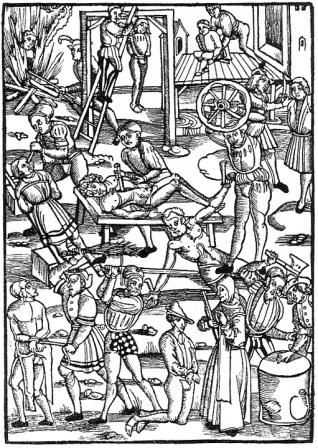
In the seventeenth century the use of torture to extract confessions and the like was de rigeur. Everybody did it. The rack, thumb screws, weights on chest – you name it. You’ve all seen these things in the horror movies.
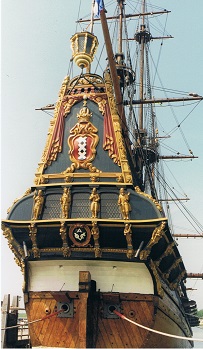
In these more enlightened times we don’t do things like that, restricting ourselves to more humane activities like water boarding, or deprivation of sensory stimuli. At least we have the sense to know that torture doesn’t necessarily illicit the truth. Be that as it may, in 1629 torture was routinely used when criminals were brought to trial and the Dutch were actually rather good at it. I’ll share a few of their inventions over the next few posts, but I’ll start with Pelsaert’s interrogation techniques when he brought Jeronimus Cornelisz and his cronies to trial for the murder of the Batavia’s survivors.
In the better dungeons, such as those in Batavia’s castle, or back home in Holland, Pelsaert could have used some of the items mentioned above and pictured at top but this was a bunch of arid islands in the middle of an uncharted ocean so he made do with what he had to hand.
Keelhauling
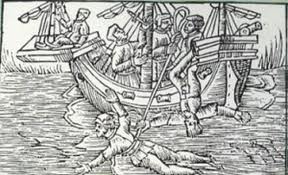
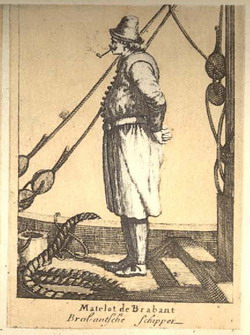
Keelhauling was apparently invented by the Dutch. Torture was a part of life and if you were out at sea you didn’t have access to the accoutrements available in the better class of dungeon so you made do with what was to hand. An inventive lot, the Dutch.
The process of keelhauling is pretty much as it sounds. A rope is passed under the keel of the moving ship. One end of the rope is tied around the victim’s arms, held above his head, the other around his body. He is then thrown into the water and towed from one side of the ship underneath the keel, to the other. Mike Dash* explains that when this punishment was first conceived, the process almost always resulted in death, either because the victim was cut to pieces on the barnacles and other growth on the wooden hull, his head was smashed in on the way around, or he drowned because he was submerged for too long.
The solution was a special harness made from lead and leather, to which the prisoner was strapped. The metal protected him from the barnacles and by using a flag on the rig and varying the length of the ropes those administering the procedure could be sure the rig was pulled across the beam of the ship and not along its length. All Dutch ships carried these harnesses, purpose built to carry out a punishment the victim would never forget.
Pelsaert sentenced a number of the men convicted of crimes on Batavia’s Graveyard to keelhauling and the punishment was carried out at the islands. Each man was supposed to have been keelhauled three times but for most, once was enough – any more and the victim could well drown. Most people in these times couldn’t swim and were terrified of the water, which would render the process even more frightening.
Having survived the keelhauling, they then each received one hundred lashes before the mast. They would have been very sore boys for a long time.
Harsh as this treatment sounds, it was still better than they would have received in the dungeons at Fort Batavia.
Dropping from the Yardarm
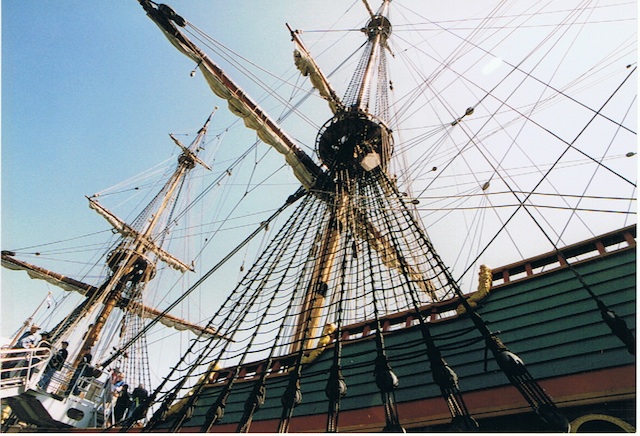
Continuing with the concept of suitable punishments while at sea, if you weren’t keelhauled you could be dropped from the yard. Masts and the accompanying yardarms were common on all ships (of course) and they provided a venue for a simple and very damaging treatment. The victim’s arms were tied behind his back, lead weights were attached to his ankles. A long rope was tied to the wrists (which were behind the back, remember). The man was then thrown off a yardarm, falling fifty feet or so toward the sea. The fall was ended when he reached the end of the rope. Needless to say, the result was usually dislocated shoulders and quite often broken wrists and ankles. As with keelhauling, this punishment was delivered in threes, so the shattered victim was pulled back up on the yardarm and dropped again. And again.
Several of Cornelisz’s accomplices convicted of lesser crimes were sentenced to this punishment. As usual, having survived being dropped, they were then flogged, as well.
Oh, what a wonderful life sailors must have led, going with the bad food, ‘off’ water, cold, damp, crowding and general discomfort.
Water torture the Dutch way
Pelsaert used a form of water torture. The prisoner was trussed up in an upright position with a waterproof canvas collar in the shape of a cone fastened around his neck. It would have reached the level of the man’s eyes – that is, water poured into the funnel would cover the mouth and nose. The victim would have no choice but to drink the water to stop himself from drowning. But of course, a point would come where the person just couldn’t drink any more. Then the interrogation would cease so the victim could be forced to vomit, then they’d start all over again. Given the scarcity of drinking water both on the ship and on the islands, I wouldn’t be at all surprised if Pelsaert used sea water for his interrogations. Stalwarts who hung out in the face of this technique could be bloated to twice their normal size, as well as exhausted and breathless.
Is this a good way of establishing facts? It would seem, reading Pelsaert’s journal of the trial, that it was a good way of getting the prisoners to condemn each other and an excellent way for the interrogators to apparently confirm any pre-conceived notions they might have had. I think they did derive some facts. Men dobbed each other in and activities such as the way in which their victims were murdered has been verified, in some cases, because the skeletal remains were found.
Still, I have my doubts. Me, I’d confess to anything to get them to stop pouring icky water into me.
Want to read the whole story? Tap here.