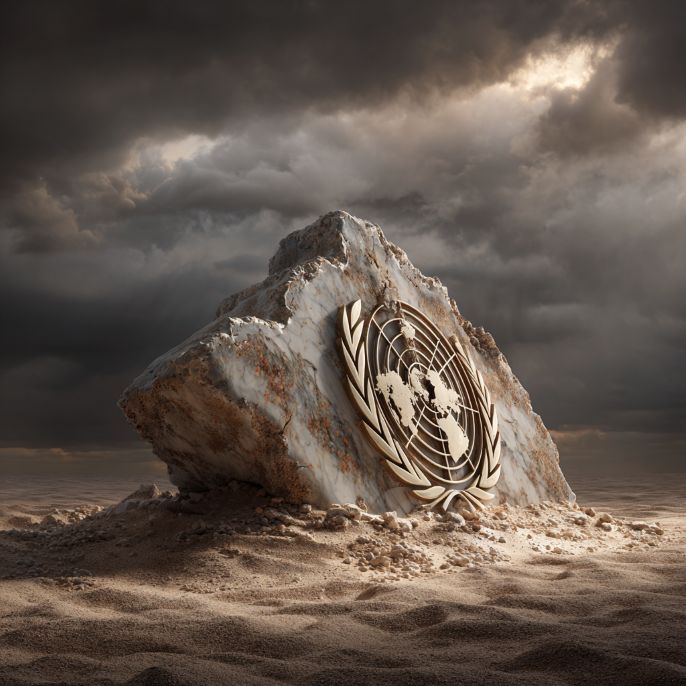
The United Nations: From Idealism to Impotence
It’s not often that I agree with the odious current occupant of the White House, but I do agree with him about the uselessness of the United Nations.
The United Nations was born out of the ashes of the Second World War. Its founders dreamed of an institution that could prevent another global catastrophe, foster cooperation, and give even the smallest nations a voice. At its heart was a noble purpose: to replace the old, bloody system of might-makes-right with one grounded in dialogue, law, and collective responsibility.
But lofty ideals are one thing. The hard reality of politics is another. Over the decades, the UN has drifted from its mission, hobbled by self-interest, corruption, and the veto power of the Security Council’s permanent members. Which, of course, showed quite conclusively how much the “Allies” of world war two (UK, USA, France, Russia, and China) trusted each other.
Let’s look at some examples of the UN in (in)action. The International Whaling Commission was supposed to protect dwindling whale populations. When a motion to stop whaling was brought to the UN Japan, determined to keep hunting whales under the guise of “scientific research,” secured support by buying votes from tiny, often cash-strapped nations. Conservation lost out to cynical deal-making.
Or consider the UN’s impotence in the face of naked aggression. When Russia invaded Ukraine, bombing cities and displacing millions, the UN issued condemnations—but little else. The Security Council, designed to act decisively against threats to peace, was paralyzed because Russia itself holds a veto. The result? Empty speeches, toothless resolutions, and a vivid demonstration of how power politics trumps principle.
The South China Sea is a live example of the UN’s paralysis. Despite an international tribunal ruling in 2016 that China’s sweeping “nine-dash line” claims have no legal basis, Beijing simply ignored it. Today, Chinese coast guard and naval vessels routinely harass ships from the Philippines, Vietnam, and other neighbors, building bases on artificial islands and enforcing their will through sheer force. The UN issues statements, but it cannot enforce its own laws or stop one of its most powerful members from doing exactly as it pleases. Just as in Ukraine, the message is clear: at the UN, might still makes right.
This isn’t new. In 1994, during the Rwandan genocide, UN peacekeepers were ordered to stand by as extremists slaughtered 800,000 people in just a hundred days. A decade earlier, in Bosnia, UN “safe zones” like Srebrenica became death traps when peacekeepers failed to stop mass killings. Both tragedies revealed a grim truth: without the political will of powerful nations, blue helmets are little more than bystanders.
Corruption has tainted the institution, too. The Oil-for-Food scandal in the 1990s, meant to allow Iraq to sell oil in exchange for humanitarian goods, instead became a scheme for kickbacks and profiteering. Billions were siphoned off while ordinary Iraqis suffered.
Yes, UN agencies still do good work—on health, refugees, food, and culture. But when it comes to global security, peace, and justice, the institution has become a stage for hypocrisy, manipulation, and paralysis.
So the question is stark: can the UN be reformed, or has its time passed? If the veto makes decisive action impossible, if corruption and vote-buying undermine its integrity, then maybe the world needs something new. An organization that truly reflects the principles of its charter—without the rot that has hollowed the UN from within.
Until then, the gap between its noble origins and its sorry present will only grow wider.
(I’ve often wondered how China got to be a permanent member. It was hardly a power in 1945. Apparently the Republic of China (ROC) was considered a victor of the war. After the Chinese Civil War, the People’s Republic of China (PRC) was founded in 1949, but the ROC, based in Taiwan, retained the UN seat. In 1971, the United Nations General Assembly voted to transfer the seat to the PRC, making the People’s Republic the representative of China on the Security Council. One other country gets a temporary seat on the security council for a two-year term. In 2025 it was Algeria’s turn. The last time Australia sat on the council was in the 2013-14 term and enabled it to help spearhead the global response to the deadly downing of MH17. All up, Australia has had a seat on the council five times since 1946.)