Punishment
Once Pelsaert had finished his trial of the conspirators who had been responsible for the deaths of nearly one hundred people on the Abrolhos islands where they had hoped for rescue, he passed sentence.
The ring leader, Jeronimus Cornelisz, along with six of his lieutenants, was hanged at the islands. In comparison with what they would have received had these men been taken to Batavia, their end was lenient. (We’ll get to that in another post.)
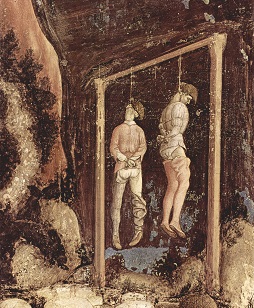
That said, hanging wasn’t the relatively merciful noose with a short drop when a trapdoor opens, which effectively breaks the victim’s neck. Death by hanging in those times was simply slow strangulation. Pelsaert’s men built a scaffold from driftwood at one end of the long island known as Seal’s Island and the condemned were strung up. In more civilised parts, hangings were sport with no doubt money changing hands over how long a man might struggle. Mike Dash speculates (Batavia’s Graveyard, p230) that Jeronimus would have taken some time to die because he wouldn’t have weighed much when he was strung up.
A number of the condemned were sentenced to have a hand cut off before they were hanged. Jeronimus was to lose both hands but Pelsaert stopped at one. It’s hard to imagine Pelsaert was being nice. Perhaps he felt that dying from blood loss was far too merciful.
It’s interesting to speculate on what caused Pelsaert to mete out punishment at the islands, rather than take the men back to Batavia. Maybe the best answer is that all these desperate men became a risk factor in a small ship carrying too many people and a lot of wealth. Apart from rescuing the survivors from the Batavia, Pelsaert had also been charged with recovering as much as he could of the silver and cargo the ship had carried, and this he had done with considerable success.
The seven bodies were, in all likelihood, left to hang, as was the normal practice throughout Europe. Apart from those executed, Pelsaert sentenced a number of Cornelisz’s thugs to ‘lesser’ punishment.
The Dutch merchantman Sardam, jammed to the gunwhales with treasure, survivors and prisoners, sailed into Batavia port on 5th December, 1629. The relief of all those people who had survived the wreck of the Batavia on the Abrolhos islands six months before can only be imagined. But while the heroes of Wiebbe’s island and the handful of victims who had not participated in Cornelisz’s reign of terror might be grateful, those in the hold who had been members of the gang were no doubt more than a little fearful. To be sure, the survivors had a tale to tell and the taverns would have rung with the telling. Pelsaert had dealt with some of the murderers. Cornelisz and his closest lieutenants were hanged back on the Abrolhos islands and others had been keelhauled, dropped from the mast or flogged. Some had begged Pelsaert to sentence them, hoping against hope that his more lenient justice would be the end of the matter.
This would not be the end of the saga for everyone, though. Pelsaert no doubt realised he would have to deliver at least one of the senior miscreants. Cornelisz’s second in command, an erstwhile lance-corporal named Pietersz, had been kept in chains to await the Governor’s pleasure. Governor Coen who had given Pelsaert his orders to rescue the Batavia‘s survivors and as much of the cargo as he could, had died while the commandeur was away on his mission, but anyone who imagined his successor, Specx, would be more lenient was to be sadly mistaken. Almost all the prisoners who had already been subjected to Pelsaert’s justice were made to face the Governor. Five more were hanged and others punished in lesser ways. Pietersz, as the only surviving member of Cornelisz’s murderous clique to make it to Batavia, received the punishment which would undoubtedly have been meted out to Cornelisz and his senior co-conspirators.
He was broken on the wheel.

Using a heavy mallet, the executioner first pulverised the prisoner’s bones, starting with the fingers and toes and working inwards. The intention was to make all the limbs flexible so that the prisoner could be wrapped around the circumference of a cartwheel. Mike Dash (“Batavia’s Graveyard”, p.238) explains that the executioners took pride in keeping the victim’s skin intact. Lashed in this way, toes around to head, Pietersz would have been left out in the main square in the sultry Indonesian heat to die in front of an audience which would have included the survivors of the atrocities.
Cornelisz’s death might not have been instant but it was a far cry from this torture. And Coenraat van Huyssen and the other conspirators who were killed by Wiebbe Hayes’ men in that abortive attack – well, they were the lucky ones.
But the courts in Batavia were not finished with the miscreants. Reading about the punishments handed out* is a fascinating indictment of the concept of ‘justice’ at that time.
Five more men were hanged, most of them deservedly. But Cornelisz was a truly evil man. He killed no one himself, just caused them to be killed. A favourite technique was to give a man a choice; kill or be killed. Salomon Deschamps, Pelsaert’s clerk, had been made to strangle a half-dead baby. Deschamps was one those hanged, while some enthusiastic murderers were at least allowed to live. One man who had killed three men was severely flogged and made to wear a heavy wooden halter around his neck. Why he escaped the gallows is hard to understand.
Then there is the case of Claas Harmansz, a fifteen year old lad. He and two other cabin boys managed to avoid the slaughter of the people on Seals Island (it’s the long, narrow island directly across the deep channel from Batavia’s Graveyard) by hiding in the shrubs. But the day came when Cornelisz ordered them caught, and drowned. In the boat on the way back from Seals Island Harmansz, tied up and awaiting death, was given a choice; throw the other two overboard, or die himself. He chose to live. Pelsaert sentenced him to 100 lashes after being dropped from the mast three times. The lad received a further flogging in Batavia.
The courts could not decide what to do with two of the youngest, most impressionable of the gang, two lads aged seventeen and fifteen. In a truly twisted piece of logic, they had the two draw lots. The loser was hanged, while the other was severely flogged and made to watch the hanging with a noose around his neck.
I’ve mentioned Jan Pelgrom, the eighteen year old who was spared the death sentence at the last moment, and was marooned instead. I wonder if he ever realised how lucky he was?
And then there were the survivors and those who had already received Pelsaert’s punishment.
Pelsaert, his reputation in tatters, was shunted off to Surat as second in command of an expedition, while his case was considered. He was dead by September 1630, having survived Jeronimus Cornelisz by less than a year. Evidence indicates he probably died of the same disease that had kept him in his bunk on both the Batavia and the Sardam.
Wiebbe Hayes, unlikely leader of the band of soldiers Cornelisz had contrived to isolate so he could carry out his plans, was promoted to officer. Given his stirling performance in leading the soldiers and later refugees from Cornelisz’s excesses, the promotion was a no-brainer (IMO). Members of his band were given a small reward for services rendered. But from there, the record ends. Most likely Hayes went off to the Company’s wars and died of wounds or maybe disease.
Predikant Bastiaensz, whose wife and all but one of his seven children were murdered, did not impress the church with how he had led his flock. In particular, questions were asked about how he had come to sign his allegiance to a heretic. Batavia’s Governor Specx was very critical of Bastiaensz’s record and it took some time before the cleric was absolved of all blame for the events on the Abrolhos. He remarried two years after his wife’s death but died of dysentery, still in the islands, in 1633.
Judyck, the predikant’s only surviving child, who was effectively given as a sex slave to one of Cornelisz’s main accomplices, had little choice but to find a husband as soon as possible. She married soon after her arrival in Batavia, but her new husband died within 3 months. Two years later she married again, moving with her husband to the island of Ambon. This marriage also ended in widowhood. Finally, the VOC repatriated her to Dordrecht in 1634, where she lived in relative comfort. There is no record of her death.
Lucretia van der Mijlen, the beautiful woman Cornelisz had lusted after, was in a different situation. Unlike Judyck, she had means as well as beauty. She married a soldier – a sergeant who Mike Dash speculates was Lucretia’s step brother-in-law– and remained in Batavia until 1635, when they returned to Holland.
And what of Adriaen Jacobsz, captain of the Batavia?
He was imprisoned almost immediately on his arrival in the longboat, accused by Commandeur Pelsaert of plotting mutiny, intending to steal his own ship. Pelsaert also implicated him in a crude attack on Lucretia van der Mijlen. There is no doubt he was tortured but resolutely proclaimed his innocence of all charges. The last reference to him was a letter written by Governor Specx in June 1631, in which he noted Jacobsz’s refusal to admit any guilt and asking to be released. There is no record of the captain’s death. I have noted elsewhere that given the VOC’s penchant for revenge, it’s an interesting omission. That he survived the dreadful, malaria-ridden dungeon of the fort of Batavia for nearly a year is remarkable in itself. However, much as I’d like to give at least one happy ending, he probably died of disease. Similarly, his girlfriend Zwaantie was tortured without result. History has not recorded what happened to her after she left the fort.
There are no happy endings in this dreadful tale of human misery. But that was life in the seventeenth century.
As usual, I’m indebted to Mike Dash Batavia’s Graveyard, Orion Books, 2002 and Henrietta Drake-Brockman’s Voyage to Disaster, UWA Press, 2006 for having researched the lives of these people.
Want to read the whole story? Tap here.




3 Comments
Comments are closed.